
Global financial markets have been steadily moving away from credit-sensitive benchmarks like LIBOR, EURIBOR, and JIBAR. South Africa is now in the midst of its own transition: the 3-month JIBAR (Johannesburg Interbank Average Rate) will be replaced by ZARONIA — the South African Rand Overnight Index Average.
This is more than just a rate change. It is a structural shift that will reshape how loans, bonds, swaps, and other instruments are priced, valued, and disclosed in financial statements.
From Credit-Risk Embedded to Risk-Free
- 3-month JIBAR is based on unsecured interbank lending, which naturally embeds the credit risk and liquidity premium of contributing banks.
- ZARONIA is calculated from actual overnight wholesale funding transactions, making it a nearly risk-free rate (RFR).
Because of this fundamental difference, a spread will always exist between the JIBAR swap curve and the ZARONIA swap curve — and that spread reflects the credit risk of the banks contributing to JIBAR.
Bootstrapping the Future: The ZARONIA Swap Curve
The South African market has reached a key milestone:
- Banks are now contributing ZARONIA OIS swap rates across maturities from overnight to 30 years.
- Using these quotes, we have bootstrapped the full ZARONIA swap curve — the curve that will replace the 3-month JIBAR swap curve in valuations.
Chart: Bootstrapped ZARONIA Swap Curve vs 3-month JIBAR Swap Curve
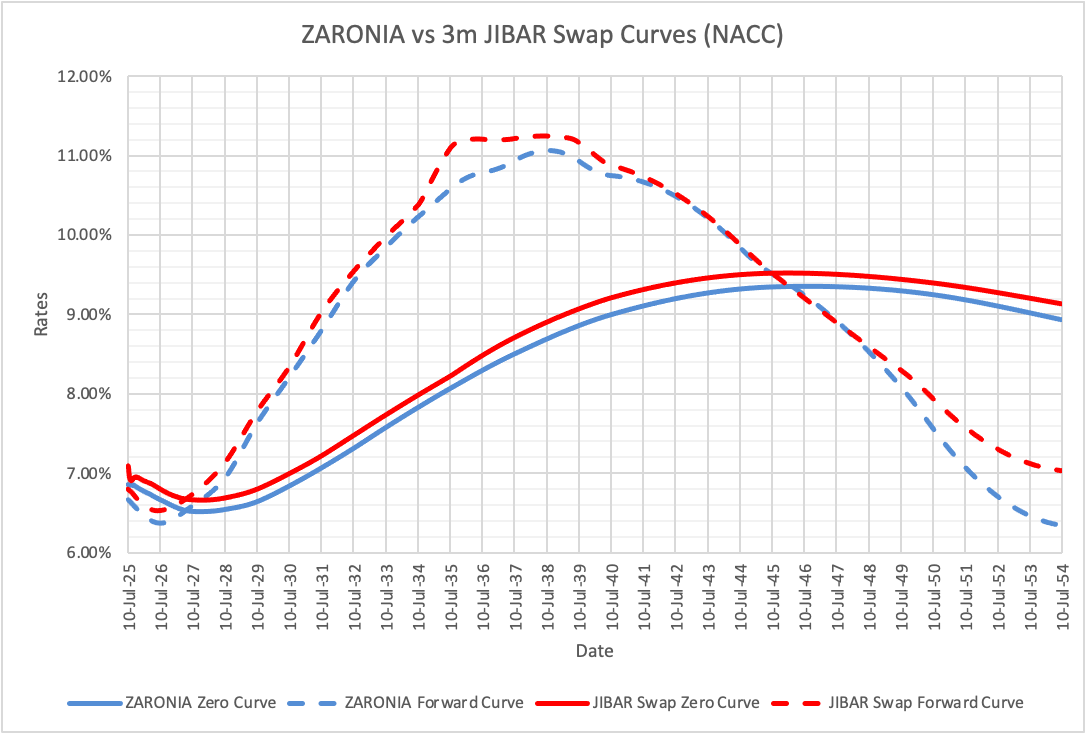
The gap between these curves is not a pricing error — it’s the market’s way of pricing credit risk out of the RFR curve.
Why CFOs Should Pay Attention
The ZARONIA swap curve will not only be the backbone of market trading but will also become a key input in financial reporting and valuation. Examples include:
- Loans at Fair Value Through Profit or Loss (FVTPL) – remeasured directly off the ZARONIA curve.
- Loans at Amortised Cost (IFRS 9) – still discounted using the ZARONIA curve when preparing IFRS 7 fair value disclosures.
- Interest Rate Swaps linked to ZARONIA – valuation and hedge effectiveness assessments will be RFR-based.
- Floating Rate Bonds with ZARONIA coupons – accurate coupon forecasts and discounting require the RFR curve.
- Basis Swaps between ZARONIA and other benchmarks – pricing relies on both curves and the credit spread between them.
- Cross Currency Swaps involving ZARONIA – integrated into multi-currency valuation frameworks.
For many corporates, these changes will require valuation model updates, system enhancements, and accounting policy considerations.
The Credit Adjustment Spread (CAS)
When JIBAR finally ceases, any instruments transitioning to ZARONIA will require a Credit Adjustment Spread (CAS) to maintain value neutrality.
- CAS ensures the economic equivalence of legacy JIBAR-linked contracts after conversion.
- The size of the CAS will be determined using market-accepted methodologies and historical spreads between the curves.
What Happens on D-Day?
On transition day:
- Existing JIBAR-linked instruments will switch to ZARONIA + CAS.
- New instruments will reference ZARONIA directly.
- Valuations, hedge relationships, and disclosures will all pivot to the RFR environment.
We will return in a future article to demonstrate exactly how the ZARONIA swap curve and CAS are applied in practice — with worked examples for loans, swaps, and bonds.
Final Word
The move from JIBAR to ZARONIA is not just a market event — it’s a valuation and reporting event. CFOs who prepare early will avoid valuation shocks, hedge disruptions, and disclosure surprises.
At Financial Minds, we have already built the tools to bootstrap, analyse, and apply the ZARONIA swap curve. If you would like to discuss the impact on your portfolio, financial statements, or hedge relationships, let’s talk.